

Health Library
Graves disease
Diffuse thyrotoxic goiter; Hyperthyroidism - Graves; Thyrotoxicosis - Graves; Exophthalmos - Graves; Ophthalmopathy - Graves; Exophthalmia - Graves; Exorbitism - Graves; Graves' disease
Graves disease is an autoimmune disease that leads to an overactive thyroid gland (hyperthyroidism). An autoimmune disease is a condition that occurs when the immune system mistakenly attacks healthy tissue.
Images
I Would Like to Learn About:
Causes
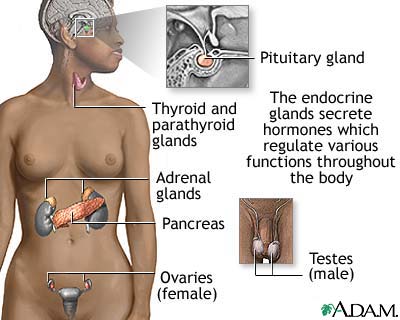
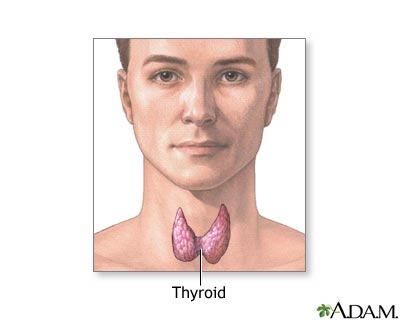
The thyroid gland is an important organ of the endocrine system. The gland is located at the front of the neck above where the collarbones meet. This gland makes and releases the hormones thyroxine (T4) and triiodothyronine (T3), which control body metabolism. Controlling metabolism is important for regulating mood, weight, and mental and physical energy levels.
When the body makes too much thyroid hormone, the condition is called hyperthyroidism. (An underactive thyroid leads to hypothyroidism.)
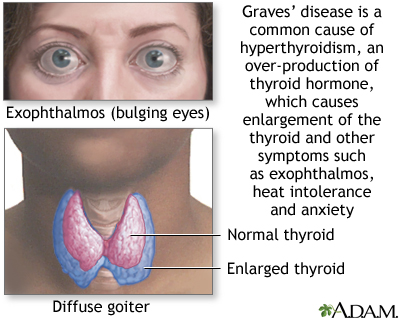
Graves disease is the most common cause of hyperthyroidism. It is due to an abnormal immune system response that causes the thyroid gland to produce too much thyroid hormone. Graves disease is most common in women over age 20. But the disorder can occur at any age and can affect men as well.
Symptoms
Younger people may have these symptoms:
- Anxiety or nervousness, as well as problems sleeping
- Breast enlargement in men (possible)
- Problems concentrating
- Fatigue
- Frequent bowel movements
- Hair loss
- Heat intolerance and increased sweating
- Increased appetite, despite having weight loss
- Irregular menstrual periods in women
- Muscle weakness of the hips and shoulders
- Moodiness, including irritability and anger
- Palpitations (sensation of a strong or unusual heartbeat)
- Rapid or irregular heartbeat
- Shortness of breath with activity
- Shaking hands (tremors)
- Weight loss
Many people with Graves disease have problems with their eyes:
- The eyeballs may seem to be bulging out and may be painful.
- Eyes can feel irritated, itchy, or tear more frequently.
- Double vision may be present.
- Decreased vision and damage to the cornea can also occur in severe cases.
Older people may have these symptoms:
- Rapid or irregular heartbeat
- Chest pain
- Memory loss or decreased concentration
- Weakness and fatigue
Exams and Tests
During the physical exam, your health care provider may find:
- You have an increased heart rate
- Your thyroid gland may be enlarged (goiter)
Other tests include:
- Blood tests to measure levels of thyroid stimulating hormone (TSH), T3, and free T4
- Blood tests to detect immune system problems related to the thyroid
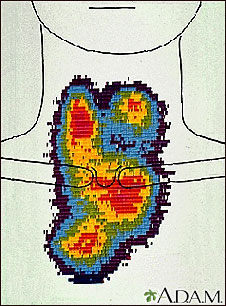
- Radioactive iodine uptake and scan
This disease may also affect the following test results:
- Orbit CT scan or ultrasound
- Thyroid stimulating immunoglobulin (TSI)
- Thyroid peroxidase (TPO) antibody
- Anti-TSH receptor antibody (TRAb)
Treatment
Treatment is aimed at controlling your overactive thyroid. You may receive one or more types of treatment.
Beta-blocker medicines may help treat:
- Rapid heart rate
- Sweating
- Anxiety
They may be given until the hyperthyroidism is controlled.
Antithyroid medicines:
- Block or change how the thyroid gland uses iodine
- May be used to control the overactive thyroid gland before surgery or radioiodine therapy
- May be used as a long-term treatment
Radioactive iodine is given by mouth. It then concentrates in the overactive thyroid tissue and causes damage.
Surgery may be done to remove the thyroid.
If you have had radioactive iodine treatment or surgery, you will need to take replacement thyroid hormones for the rest of your life. This is because these treatments destroy or remove the gland.
TREATMENT OF THE EYES
Some of the eye problems related to Graves disease often improve after treatment with medicines (including selenium), radiation, or surgery. Radioiodine therapy can sometimes make eye problems worse. Eye problems are worse in people who smoke, even after the hyperthyroidism is treated.
Sometimes, prednisone is needed to reduce eye irritation and swelling. Prednisone is a steroid medicine that suppresses the immune system. Other treatments to suppress the immune system may be needed. Ask your provider if these would help you.
Sunglasses, cool compresses, and eye drops may reduce eye irritation. In rare cases, surgery or radiation therapy (different from radioactive iodine) may be needed to prevent further damage to the eye and loss of vision.
Outlook (Prognosis)
Graves disease often responds well to treatment. Thyroid surgery or radioactive iodine often will cause an underactive thyroid (hypothyroidism). Without getting the correct dosage of thyroid hormone replacement, hypothyroidism can lead to:
- Depression
- Mental and physical sluggishness
- Weight gain
- Dry skin
- Constipation
- Cold intolerance
- Abnormal menstrual periods in women
When to Contact a Medical Professional
Contact your provider if you have symptoms of Graves disease or your eye problems or other symptoms get worse or do not improve with treatment.
Go to the emergency room or call 911 or the local emergency number if you have symptoms of hyperthyroidism with:
- Decrease in consciousness
- Fever
- Rapid, irregular heartbeat
- Sudden shortness of breath
Related Information
HyperthyroidismEndocrine glands
Free T4 test
T3 test
Metabolism
Hypothyroidism
Eyes - bulging
Pulse - bounding
Atrial fibrillation and atrial flutter
References
Hollenberg A, Wiersinga W, Bartalena L, Feldt-Rasmussen U. Hyperthyroid disorders. In: Melmed S, Auchus RJ, Goldfine AB, Rosen CJ, Kopp PA, eds. Williams Textbook of Endocrinology. 15th ed. Philadelphia, PA: Elsevier; 2025:chap 10.
Pearce EN, Hollenberg AN. Thyroid. In: Goldman L, Cooney KA, eds. Goldman-Cecil Medicine. 27th ed. Philadelphia, PA: Elsevier; 2024:chap 207.
Smith JR, Wassner AJ. Thyrotoxicosis. In: Kliegman RM, St. Geme JW, Blum NJ, et al, eds. Nelson Textbook of Pediatrics. 22nd ed. Philadelphia, PA: Elsevier; 2025:chap 606.
BACK TO TOPReview Date: 1/25/2026
Reviewed By: Sandeep K. Dhaliwal, MD, board-certified in Diabetes, Endocrinology, and Metabolism, Springfield, VA. Also reviewed by David C. Dugdale, MD, Medical Director, Brenda Conaway, Editorial Director, and the A.D.A.M. Editorial team.
 | A.D.A.M., Inc. is accredited by URAC, for Health Content Provider (www.urac.org). URAC's accreditation program is an independent audit to verify that A.D.A.M. follows rigorous standards of quality and accountability. A.D.A.M. is among the first to achieve this important distinction for online health information and services. Learn more about A.D.A.M.'s editorial policy, editorial process and privacy policy. A.D.A.M. is also a founding member of Hi-Ethics. This site complies with the HONcode standard for trustworthy health information: verify here. |
The information provided herein should not be used during any medical emergency or for the diagnosis or treatment of any medical condition. A licensed medical professional should be consulted for diagnosis and treatment of any and all medical conditions. Links to other sites are provided for information only -- they do not constitute endorsements of those other sites. No warranty of any kind, either expressed or implied, is made as to the accuracy, reliability, timeliness, or correctness of any translations made by a third-party service of the information provided herein into any other language.
© 1997-
2026 A.D.A.M., a business unit of Ebix, Inc. Any duplication or distribution of the information contained herein is strictly prohibited.
All content on this site including text, images, graphics, audio, video, data, metadata, and compilations is protected by copyright and other intellectual property laws. You may view the content for personal, noncommercial use. Any other use requires prior written consent from Ebix. You may not copy, reproduce, distribute, transmit, display, publish, reverse-engineer, adapt, modify, store beyond ordinary browser caching, index, mine, scrape, or create derivative works from this content. You may not use automated tools to access or extract content, including to create embeddings, vectors, datasets, or indexes for retrieval systems. Use of any content for training, fine-tuning, calibrating, testing, evaluating, or improving AI systems of any kind is prohibited without express written consent. This includes large language models, machine learning models, neural networks, generative systems, retrieval-augmented systems, and any software that ingests content to produce outputs. Any unauthorized use of the content including AI-related use is a violation of our rights and may result in legal action, damages, and statutory penalties to the fullest extent permitted by law. Ebix reserves the right to enforce its rights through legal, technological, and contractual measures.
